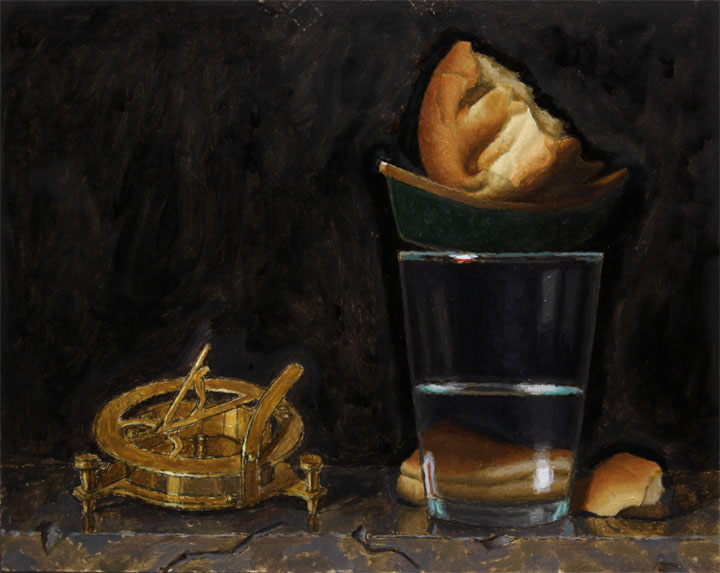
There are as many different ways to compose a painting, it often seems, as there are stars in the galaxy. Everyone seems quite sure that their way is the best way! We have your "golden sectionistas", your "sight sizers", your "Durer gridians", even your "rule of thirders" (borrowed from photography). Everyone seems to be searching for that easy way to come up with a "great" composition, every time. Then we have the "de-bunkers" who use eye tracking studies and optical science to prove why everyone else's method is a bunch of crap (excuse my English). Honestly, it's enough to make the poor itinerant artist freeze with fear each time they begin a new work.
Well folks, I'm hear to tell you that I have all of the answers and you'll never have to worry again!(Not!!) Although I love to read about all of these various methods, I have to confess, that my own method of composing a picture is quite a bit simpler. I take two L-shaped pieces of cardboard, about four inches in length, then I put them together with paper clips to form a rectangle. Some artists like to draw directly on their canvas, some like to draw on paper and then frame it out afterwards to see which size canvas to use, some like to put the canvas on the floor and wait until it looks interesting enough, with spots and stains, to generate an idea (Walter Murch actually did that!). I start with a canvas which I have traced the size onto a sheet of drawing paper. I then take my home made viewfinder and sight through it while looking at my traced rectangle and adjust it until the dimensions match. I look through my viewfinder at my setup, with one eye closed, like a pirate, it's sometimes helpful to say "arggh, shiver me timbers" while doing this. If I don't like what I see I keep adjusting things until it "feels right". Not very scientific, I know, but I have learned to trust my instincts because I have worked very hard to have them.
Another reason that I start with the traced rectangle is that I use the sides of the rectangle to mark off vertical lines so that they are parallel. Here's another "old weird dude" tip, I never use a ruler for measuring or drawing straight lines. I use a compass to mark off points and then I freehand the connecting lines. I have this idea in my head that the drawing, and subsequently the painting, would look too mechanical, too much like an architectural rendering. I remember Harold Speed in "The Practice and Science of Drawing" saying that a work of art should have a certain amount of "dithering" in it, that perfection wasn't really the goal. I'm sure he would consider me a "dithering" fool! And just to be clear, I want you to know that I'm certain that this method is truly one of the greatest lost tricks of the old masters and I'm currently working on a book with lots of diagrams to prove it. So there!
Showing posts with label painting. Show all posts
Friday, February 10, 2017
Monday, January 23, 2017
New Year, New Resolve
Ingres is reported to have said that "drawing is the probity of art". My interpretation is that he meant that drawing is truth, and without it a work of art lacks a solid foundation. Whenever I start to feel as if I'm running in place, not advancing as far in my work as I would like, I know that I can go back to the source, drawing, and work my way from there. It's such a simple and basic process, yet profoundly engaging, and often frustrating. My academic training has gotten me away from the "contour line", one shot method, that was emphasized in high school and college, and more towards something fluid; like shaping clay for a sculpture. The nebulous quality of my initial straight line block-in pencil marks, gradually become more refined, and my analytical thought processes undergo a similar refinement. In this way each drawing becomes a new adventure, a self discovery that never seems rote or repetitive.
With the advent of the new year I've decided to push myself a bit harder on the drawing front. I feel like I haven't fully made use of all that drawing has to offer in terms of advancing my art and so I'm determined to increase my focus. Normally I start a painting by making an actual size drawing, sometimes called a "cartoon", and then transferring it to my canvas. This is done on white sketchpad paper. I do spend quite a bit of time on the drawing, and I keep pushing it until I feel it's "canvas ready". I use a mirror often to check for mistakes, and I do a lot of measuring, and cross measuring. So, what else could I do, one might ask? Usually my painting concept is based on a small thumbnail sketch. I'm going to start making larger, slightly more refined sketches, maybe on toned paper, that include a value study as well. I want to use the drawing as a way of working out several possibilities in each arrangement that I set up, so as to arrive at the best solution. I also want to make individual studies of elements in the setup in order to better understand their individual specifics before encompassing them in the harmony of the overall design.
This is the "cartoon" for a painting that I'm currently about to start. At this point I've transferred it to a canvas, but I haven't started to paint it yet. If I were following my new years resolutions, I would not have made this drawing full size and transferred it without having first made some drawing studies and even some painted studies. It's not that I'm not happy with the drawing, I am, and I'm excited to paint it, it's really just a feeling I have that I need to push myself a little harder to not just come up with an idea but to come up with the best version of that idea. I did however make two miniature transfers on 5 x 7 inch panels on which I'll do a black and white and a color poster study. It's not completely what I resolved to do but it's not a total "cheat" on my "New Years Resolutions", so I'll take it and try to do more on the next one (isn't that what resolutions are all about?).
With the advent of the new year I've decided to push myself a bit harder on the drawing front. I feel like I haven't fully made use of all that drawing has to offer in terms of advancing my art and so I'm determined to increase my focus. Normally I start a painting by making an actual size drawing, sometimes called a "cartoon", and then transferring it to my canvas. This is done on white sketchpad paper. I do spend quite a bit of time on the drawing, and I keep pushing it until I feel it's "canvas ready". I use a mirror often to check for mistakes, and I do a lot of measuring, and cross measuring. So, what else could I do, one might ask? Usually my painting concept is based on a small thumbnail sketch. I'm going to start making larger, slightly more refined sketches, maybe on toned paper, that include a value study as well. I want to use the drawing as a way of working out several possibilities in each arrangement that I set up, so as to arrive at the best solution. I also want to make individual studies of elements in the setup in order to better understand their individual specifics before encompassing them in the harmony of the overall design.
This is the "cartoon" for a painting that I'm currently about to start. At this point I've transferred it to a canvas, but I haven't started to paint it yet. If I were following my new years resolutions, I would not have made this drawing full size and transferred it without having first made some drawing studies and even some painted studies. It's not that I'm not happy with the drawing, I am, and I'm excited to paint it, it's really just a feeling I have that I need to push myself a little harder to not just come up with an idea but to come up with the best version of that idea. I did however make two miniature transfers on 5 x 7 inch panels on which I'll do a black and white and a color poster study. It's not completely what I resolved to do but it's not a total "cheat" on my "New Years Resolutions", so I'll take it and try to do more on the next one (isn't that what resolutions are all about?).
Friday, December 23, 2016
How To Get Your Work Into A Gallery Part Two
In part one I discussed how I was able to get a gallery to exhibit my work. There are a lot of books out there that will give you the formula for how to go about doing this. These books sell very well, I've bought a few of them myself. The problem is that the methods they give don't really work. If there's one rule in life that always seems to hold true it's that the squeaky wheel always gets the grease. Not the cleanest wheel, or best made wheel, or most unique wheel, THE SQUEAKIEST! So you have to throw away the rule book and get your stuff seen by any means possible. One key ingredient that the books don't mention is chutzpah, it's an old Yiddish word for having a lot of nerve. I'm sure I would be a lot further along in my career if I had more of this essential ingredient. Of course it goes without saying that you have to believe that you are doing good work that is worth being seen and that's saleable. In the first mailing that I sent out I mentioned to the gallery owners that if they put my work on their walls that it wouldn't be there for very long, the stuff would be flying out the door. That got their attention. That's a little bit of chutzpah, I certainly could of been a bit bolder and told them that in person, but I chickened out!
Anytime I hear or read a gallery interview they always say that the biggest no-no is to walk in with your work unannounced. Yet I have read on more than a few occasions of artists walking in and doing just that, and the gallery taking them on. The bottom line is that if your work blows them away they are not going to reject you just because you barged in! They are looking for the next big moneymaker! Sure they don't want it to become a common practice, but it has occasionally happened and worked out for the artist. I have practiced a few sneaky introductions myself. One year I took a letter box at a post office in Soho so that the galleries would think I was a New York City artist. It almost worked. I can remember retrieving my mail and opening a letter from the OK Harris Gallery that started with the line "Congratulations", I almost passed out. But then it went on to say that my work was really first rate and deserving of a gallery, just not his. He went on to list galleries that he thought might like my work but said that he didn't want me to say that he recommended me. "Say what?" Wahh-wahh! Being the naïve do-gooder kid that I was, I didn't use his name and I got nowhere fast. In hindsight I probably should have copied that letter and included it with every packet that I sent. Why not, I worked hard and deserved it. Another method that I tried was in the days of sending slide sheets. Instead of sending slide sheets, I sent a slide sheet folder filled with miniature hand painted versions of twenty of my paintings which I had encased in a slide negative cardboard holder so that at first glance it looked like a sheet of slides. The gallery owner wrote me back a very encouraging letter, I could tell he was impressed, but he didn't commit. Always a brides maid never a bride. I supposed if I didn't have a life that I could have nurtured that relationship like one of those potato plants in middle school science, hoping that it would one day turn into a beautiful flower. Instead, I moved on, and didn't quit. You have to be in this for the long game, and you have to have a thick skin! I have enough rejection letters to insulate my house. I'm a bit like that psychotic rabbit boiler played by Glenn Close " I will not be ignored".
Most of these so called experts also recommend that you have a signature style or theme. Yes, there are artists who paint variations on the same idea over and over again, and do very well for themselves. That could possibly work, but it just sounds so boring!! I had one gallery that was interested in my work tell me that they really loved my painting of a jawbone placed on a book, and could I possibly paint twenty more just like it. Yeah, maybe if I was suicidal and wanted to spend the next year or so contemplating the folly of human existence. Here's the bottom line; do your thing, whatever that is, don't try to figure out what the "next big thing" is. There's an audience and a market out there for good, honest work, finding them is the hard part, but it's also part of the game. Whenever I run a marathon or long race people always ask me "How was it?". I always shrug my shoulders and say "eh", because to me the training leading up to it was the best part, the race itself was kind of anti-climactic. So stop kvetching, get your work out there and enjoy the "hunt".
Anytime I hear or read a gallery interview they always say that the biggest no-no is to walk in with your work unannounced. Yet I have read on more than a few occasions of artists walking in and doing just that, and the gallery taking them on. The bottom line is that if your work blows them away they are not going to reject you just because you barged in! They are looking for the next big moneymaker! Sure they don't want it to become a common practice, but it has occasionally happened and worked out for the artist. I have practiced a few sneaky introductions myself. One year I took a letter box at a post office in Soho so that the galleries would think I was a New York City artist. It almost worked. I can remember retrieving my mail and opening a letter from the OK Harris Gallery that started with the line "Congratulations", I almost passed out. But then it went on to say that my work was really first rate and deserving of a gallery, just not his. He went on to list galleries that he thought might like my work but said that he didn't want me to say that he recommended me. "Say what?" Wahh-wahh! Being the naïve do-gooder kid that I was, I didn't use his name and I got nowhere fast. In hindsight I probably should have copied that letter and included it with every packet that I sent. Why not, I worked hard and deserved it. Another method that I tried was in the days of sending slide sheets. Instead of sending slide sheets, I sent a slide sheet folder filled with miniature hand painted versions of twenty of my paintings which I had encased in a slide negative cardboard holder so that at first glance it looked like a sheet of slides. The gallery owner wrote me back a very encouraging letter, I could tell he was impressed, but he didn't commit. Always a brides maid never a bride. I supposed if I didn't have a life that I could have nurtured that relationship like one of those potato plants in middle school science, hoping that it would one day turn into a beautiful flower. Instead, I moved on, and didn't quit. You have to be in this for the long game, and you have to have a thick skin! I have enough rejection letters to insulate my house. I'm a bit like that psychotic rabbit boiler played by Glenn Close " I will not be ignored".
Most of these so called experts also recommend that you have a signature style or theme. Yes, there are artists who paint variations on the same idea over and over again, and do very well for themselves. That could possibly work, but it just sounds so boring!! I had one gallery that was interested in my work tell me that they really loved my painting of a jawbone placed on a book, and could I possibly paint twenty more just like it. Yeah, maybe if I was suicidal and wanted to spend the next year or so contemplating the folly of human existence. Here's the bottom line; do your thing, whatever that is, don't try to figure out what the "next big thing" is. There's an audience and a market out there for good, honest work, finding them is the hard part, but it's also part of the game. Whenever I run a marathon or long race people always ask me "How was it?". I always shrug my shoulders and say "eh", because to me the training leading up to it was the best part, the race itself was kind of anti-climactic. So stop kvetching, get your work out there and enjoy the "hunt".
Thursday, December 8, 2016
How To Get Your Work Into A Gallery With Zero Connections
"How to Get Into A Gallery Without Any Connections Whatsoever!"
I have this feeling that many artists are out there waiting to be discovered. Like Marilyn Monroe sipping a coke in a drugstore, they are waiting for someone to swoop in and give them the artist's life that they have always dreamed of. Galleries and the people connected with them seem out of reach. Everything they read about the do's and don'ts of getting a gallery make it seem impossible without having some kind of inside track. Well I'm hear to tell you, brother's and sister's, it just ain't so. Sure having someone to recommend you would be nice, but what do you do if you're making great work out somewhere in the hinterlands where nobody knows the difference between you and a cold sweat?
I currently have work for sale in four galleries. Some of them I have a consignment deal with, and some of them have added me to their roster. In terms of sales one way doesn't necessarily work better than the other. The bottom line is you want your stuff to sell before your painting in a tiny little corner of your studio with all of your paintings lumbering over you like the ghost of Christmas past. So how did I get these galleries to show my work, without anyone, and I mean no one, not even a sixth degree of Kevin Bacon recommending me? I use the skeet shooting method. Sure it looks real impressive when you see these guys aiming for these clay pigeons and hitting them mid air, until you realize that they are shooting buckshot (scattered pellets) and not hitting them with a single shot. All of the books that I've read say you should choose just a couple of galleries that your interested in and find out everything that you can about them. Go to the gallery, talk with the owners, go to openings, throw dinner parties etc; PLEASE, is that the way AMAZON works? Not according to the barrage of emails I get every day.
I got into my first real gallery about ten years ago. My approach was so low-tech that it amazes me to think about it, even still. At this time artists were still using slides (remember that unholy nightmare), and I found this place that was reasonably priced for getting your work photographed, and the slides were good quality. I then had the slides printed as 5 by 7's and scanned them into my computer. I used the Windows photo printing program, no Photoshop for this buckaroo, and printed a sheet with six of my paintings equally spaced. This is all true I swear! I next printed out labels and a heading for the sheet of paintings and re-scanned the image. I took it to Kinkos (now FedEx) and had a hundred copies made on glossy card stock. I then went through every art magazine I could find (most of them piled up in the bathroom for fine reading) and put together a list of a hundred galleries that I thought I might have the slimmest possible chance of connecting with. I mailed out a packet with my homemade giant postcard, printed resume, and cover letter. I sent them out hoping for the best, but expecting the worst. Like that old commercial used to say "Set it and forget it!". I didn't do any of the things that the "art advisors" recommend. I didn't wait a week and place a follow up call, I didn't email that the packet was sent. I really didn't do anything but wait. Eventually I started to get responses. I heard from six galleries that were somewhat interested. That may not sound like a lot, but remember I was only really looking for one. What happened next? Be sure to learn more in How To Get A Gallery, Part Two. If you like this blog, please follow me and share with your friends. Thanks for reading!
Saturday, July 30, 2016
"Admiration" Process and Progress Shots
Recently I read an article by an artist who was wondering if it's a mistake for artists to post work in progress shots of their artwork. His feeling was that it was somehow taking away some of the mystery of the work and possibly devaluing it by too much exposure. I'm not necessarily the biggest fan of the social media age, but one of the best things to come of all of this, is the glimpse into the studios and working habits of artists that I admire but will never get a chance to meet. I was able to introduce my work and get accepted into a new gallery, and this came about entirely through social media. So here's a look into the creation of one of my latest, "Admiration", oil on panel, 16" x 20".
My initial concept for this painting was to show how our vision and perceptions of the world around us has been filtered through technology and how eventually we have to bring it back to looking at nature if we want to remove the scales from our eyes. How many times will a realist painter have to hear the compliment that it looks just like a photograph, when what they should be hearing is that it looks perfectly natural! I wanted to paint this one using daylight to add another "natural" element to my concept. Once I had set up the vase of flowers with the wooden bowl, I began to look for other circular forms and shapes to add to the composition. I had recently been talking with some students about the apocryphal story of how Giotto submitted a drawing of a circle to the Pope when he asked for a sample of his work, and how Rembrandt included two circles in the background of his self portrait, as if to say "I'm twice as good as Giotto". Once I added the wooden pulley, and silver bowl, the painting really began to take on a mind of it's own (yes sometimes that really does happen, it's not just artist b.s.) I start my making a careful drawing on paper, sized to the canvas, which I transfer using conte crayon on the back of the drawing. I used to save every drawing that I made, thinking I would need them for the eventual retrospective I was going to have, but my studio is small and I just can't store them, so now I use the originals and don't have to deal with the idiots at the copy center. Here's a shot of the transfer with a wipeout using thinned down raw umber. My wipeouts are kept fairly simple; two values. My theory is that if the painting doesn't grab me with a two value structure, it's not going to grab me with twenty.
My next step is to make a color wash. Most artists thin their paint way down so that it appears almost like a watercolor. I put my paint on thin, but more opaque than a watercolor. I try to get it as much "like" in the color wash pass as I can, so that I can get it even more "like" in the finishing pass. I got this idea from reading Solomon J. Solomon and a workshop I took with Douglas Flynt. I used to make color studies for each painting, and I probably still should, but I've got a lot of ideas in my head, and I'm no "spring chicken" if you get my drift. I paint the color wash very carefully moving from form to form, usually starting with the center of interest and fanning out form there. Here's a shot of the color wash in progress.
Once the color wash is dry it's time for deja-vu all over again (thanks Yogi Berra). I repaint every part of the painting exactly as I did it the first time, except now I'm noticing some things I didn't pick up on before, and I'm thickening up the lights a bit. My goal is to stay with each form, in a Zen like manner, until I'm completely satisfied, working wet into wet. I don't leave myself a back door option of fixing it later. I will occasionally repaint an area, but I never find it to be as satisfying as getting it right the first time. It loses some of the freshness and snappy brush work! I've always worked this way, even before studying at an atelier, and just assumed I was doing it wrong. Now I don't care, this is how I paint, take it or leave it. Below is a shot of the final painting. This is one of those rare instances where the painting comes close to my initial concept. Let's face it, no painting is ever going to be as vivid as that initial bolt of lightning when an idea just pops into your head and you see it clear as day for one fleeting second. I guess that's the windmill that keeps me coming back.
My initial concept for this painting was to show how our vision and perceptions of the world around us has been filtered through technology and how eventually we have to bring it back to looking at nature if we want to remove the scales from our eyes. How many times will a realist painter have to hear the compliment that it looks just like a photograph, when what they should be hearing is that it looks perfectly natural! I wanted to paint this one using daylight to add another "natural" element to my concept. Once I had set up the vase of flowers with the wooden bowl, I began to look for other circular forms and shapes to add to the composition. I had recently been talking with some students about the apocryphal story of how Giotto submitted a drawing of a circle to the Pope when he asked for a sample of his work, and how Rembrandt included two circles in the background of his self portrait, as if to say "I'm twice as good as Giotto". Once I added the wooden pulley, and silver bowl, the painting really began to take on a mind of it's own (yes sometimes that really does happen, it's not just artist b.s.) I start my making a careful drawing on paper, sized to the canvas, which I transfer using conte crayon on the back of the drawing. I used to save every drawing that I made, thinking I would need them for the eventual retrospective I was going to have, but my studio is small and I just can't store them, so now I use the originals and don't have to deal with the idiots at the copy center. Here's a shot of the transfer with a wipeout using thinned down raw umber. My wipeouts are kept fairly simple; two values. My theory is that if the painting doesn't grab me with a two value structure, it's not going to grab me with twenty.
My next step is to make a color wash. Most artists thin their paint way down so that it appears almost like a watercolor. I put my paint on thin, but more opaque than a watercolor. I try to get it as much "like" in the color wash pass as I can, so that I can get it even more "like" in the finishing pass. I got this idea from reading Solomon J. Solomon and a workshop I took with Douglas Flynt. I used to make color studies for each painting, and I probably still should, but I've got a lot of ideas in my head, and I'm no "spring chicken" if you get my drift. I paint the color wash very carefully moving from form to form, usually starting with the center of interest and fanning out form there. Here's a shot of the color wash in progress.
Once the color wash is dry it's time for deja-vu all over again (thanks Yogi Berra). I repaint every part of the painting exactly as I did it the first time, except now I'm noticing some things I didn't pick up on before, and I'm thickening up the lights a bit. My goal is to stay with each form, in a Zen like manner, until I'm completely satisfied, working wet into wet. I don't leave myself a back door option of fixing it later. I will occasionally repaint an area, but I never find it to be as satisfying as getting it right the first time. It loses some of the freshness and snappy brush work! I've always worked this way, even before studying at an atelier, and just assumed I was doing it wrong. Now I don't care, this is how I paint, take it or leave it. Below is a shot of the final painting. This is one of those rare instances where the painting comes close to my initial concept. Let's face it, no painting is ever going to be as vivid as that initial bolt of lightning when an idea just pops into your head and you see it clear as day for one fleeting second. I guess that's the windmill that keeps me coming back.
Thursday, May 12, 2016
The Other Side of the Fence
Recently, I was asked to be the sole juror for a local art club's annual members competition. I somewhat reluctantly accepted because I have had a somewhat contentious history with thirty years of submitting work to juried shows, and I didn't want anyone to be having those same evil thoughts about me! I do have some experience. I've been on the jurying committee of a well known art organization for some time, and I've done a few smaller shows on my own. The good thing about this show was that I could judge from actual work. The awards were to be given out immediately following my jurying so it was a little bit stressful, as all of the artists were there, and I was expected to explain my selections and also to give out some critiques if asked. The work was all pretty good which made choosing the better pieces even more complicated.
The art club had a form that they wanted me to fill out for the award winners that asked me to expand on things like the use of the elements and principles of art, technique, and expression. After emphasizing the elements and principles of art to high school students for over thirty years I can't tell you how many times I was pleasantly surprised when students would come up with their own solutions. I've come to realize that there are things that go into the creation of a successful work of art besides the standard "rules". I explained to the club members that to my way of thinking all art is essentially abstract and good underlying design structure is important no matter what your means of expression is. What makes a good design is somewhat debatable I guess but it seems to be something that's obvious even to "untrained" eyes. I have occasionally had something pointed out to me as a problem in my painting by a casual stranger, and son of a gun, most of the time they're right. (I really hate that!)
One of the judging categories was "expression" and I have to say that I find that to be the least important element. In my undergraduate and graduate studies in painting expression was the God before which we all knelt. As I got older and began to re-train myself, I stopped worrying about whether or not I was expressing myself and just tried to make good paintings. I remember bringing some paintings to a gallery owner at the recommendation of one of my instructors. The owner asked me how I would describe my "style". I told her that I was working very hard not to have one. I guess she thought I was a little crazy but eventually she got the idea. More important than "expression" is harmony. Does the work hold together? We've all had those pieces where we love one little section of passage in a work at the expense of the other 70% of surface area. Each art work is a specific entity with it's own rules and logic. What worked in your last painting won't necessarily work in this one, you have to problem solve on a case by case basis. That's one of the things that I love about the process, it never gets boring. It can also make critiquing work somewhat problematic. I told the artists in the club that rather than me pointing out what I think might be "wrong" in their painting or drawing, it would be better if they asked me for advice on how to problem solve something that was troubling them. As I explained, what might be wrong in this work, could be right in the next.
At the end of the evening we got into a discussion about submitting work digitally to competitions. The biggest problem with digital submissions is that you are using one art form, photography, to stand in for another art form, painting, drawing, sculpture, etc; All of the things that work well in photographs, value contrasts, flattening, perspective exaggerations, can be murder on an image of a painting. As someone who has been judging work digitally, I am often amazed at the difference between the image and the real thing. One thing that will come through, even in a digital image, is a strong design (going back to my first point). I explained that if you're going to submit work to online competitions sometimes you have to go with the work that looks the best digitally, not necessarily what you see as the best in your studio. I use to pay photographers to photograph my work, but I was never completely satisfied with the results. They were seeing things from the photographers point of view. Once I learned to take my own photos I was able to limit the shortcomings from actual image to digital version as much as I could. The internet has opened up a whole new world for artists, but it's far from perfect. I often think of the Impressionists and their dealings with the official salon juries and wonder what they would have made of today's world of electronic jurying. Perhaps they would have revolted, maybe we should too.
The art club had a form that they wanted me to fill out for the award winners that asked me to expand on things like the use of the elements and principles of art, technique, and expression. After emphasizing the elements and principles of art to high school students for over thirty years I can't tell you how many times I was pleasantly surprised when students would come up with their own solutions. I've come to realize that there are things that go into the creation of a successful work of art besides the standard "rules". I explained to the club members that to my way of thinking all art is essentially abstract and good underlying design structure is important no matter what your means of expression is. What makes a good design is somewhat debatable I guess but it seems to be something that's obvious even to "untrained" eyes. I have occasionally had something pointed out to me as a problem in my painting by a casual stranger, and son of a gun, most of the time they're right. (I really hate that!)
One of the judging categories was "expression" and I have to say that I find that to be the least important element. In my undergraduate and graduate studies in painting expression was the God before which we all knelt. As I got older and began to re-train myself, I stopped worrying about whether or not I was expressing myself and just tried to make good paintings. I remember bringing some paintings to a gallery owner at the recommendation of one of my instructors. The owner asked me how I would describe my "style". I told her that I was working very hard not to have one. I guess she thought I was a little crazy but eventually she got the idea. More important than "expression" is harmony. Does the work hold together? We've all had those pieces where we love one little section of passage in a work at the expense of the other 70% of surface area. Each art work is a specific entity with it's own rules and logic. What worked in your last painting won't necessarily work in this one, you have to problem solve on a case by case basis. That's one of the things that I love about the process, it never gets boring. It can also make critiquing work somewhat problematic. I told the artists in the club that rather than me pointing out what I think might be "wrong" in their painting or drawing, it would be better if they asked me for advice on how to problem solve something that was troubling them. As I explained, what might be wrong in this work, could be right in the next.
At the end of the evening we got into a discussion about submitting work digitally to competitions. The biggest problem with digital submissions is that you are using one art form, photography, to stand in for another art form, painting, drawing, sculpture, etc; All of the things that work well in photographs, value contrasts, flattening, perspective exaggerations, can be murder on an image of a painting. As someone who has been judging work digitally, I am often amazed at the difference between the image and the real thing. One thing that will come through, even in a digital image, is a strong design (going back to my first point). I explained that if you're going to submit work to online competitions sometimes you have to go with the work that looks the best digitally, not necessarily what you see as the best in your studio. I use to pay photographers to photograph my work, but I was never completely satisfied with the results. They were seeing things from the photographers point of view. Once I learned to take my own photos I was able to limit the shortcomings from actual image to digital version as much as I could. The internet has opened up a whole new world for artists, but it's far from perfect. I often think of the Impressionists and their dealings with the official salon juries and wonder what they would have made of today's world of electronic jurying. Perhaps they would have revolted, maybe we should too.
"Behind the Scenes" oil on panel
Tuesday, January 12, 2016
"True North"
These are what's currently on my easel. As I stated in my last post I've begun to make enlarged versions of smaller paintings. Both of these paintings "True North" 8"x10" and 16" x 20", are shown in progress. They started with transfer drawings (thank God for FedEx), and then I did a raw umber wipeout, a detailed color wash, and I've given a final finish to the bread and the canoe and glass. It might seem strange that I'm painting simultaneously what might seem like a study and a larger version, but both are painted directly from life and the perishable bread has to be completed before it rots. I'm really enjoying this process and I'm thinking of going even larger with the next one. FedEx told me they can enlarge up to 48". Woohoo!
Monday, December 14, 2015
"Going Bananas"
Lately I've been toying with the idea, actually more than toying, I've started to act on it, of starting a new, more focused body of work. Not that my work lacks focus, I think I clearly have some reoccurring themes, but I'm thinking of narrowing that focus a bit to see where it takes me. I'm starting to realize that I prefer the simpler compositions in my smaller works to the more complex ones in my larger pieces. I think it may be that the simpler arrangements seem more iconic, more monumental, and the arrow, so to speak, goes directly to the bullseye. With that in mind I started an 8"x10" painting of a banana placed on a miniature canoe that sits on top of a cigar box. Once the drawing was done I took it over to the copy center to have it enlarged to a 16"x20". A task that I thought would be easy but that actually drove the clerk a little crazy. It was worth it! It was great to see the sketch enlarged. Originally I was going to complete the small painting first as a kind of study but I decided to work on them simultaneously because for one thing, the colors were already mixed, and the fruit wasn't going to last too much longer. The other factor that motivated me to give this a try was the fact that I paint in an alla prima method. That means I work wet into wet. I don't glaze or scumble. The brushwork is actually quite fluid, but you have to get pretty close to see it. By enlarging the scale of my smaller pictures, I realized that I would also be enlarging my brushwork and that's something that I've been wanting to do for a while. I already have a truckload of thumbnail sketches worked out, so we'll see what happens, if this is a passing fancy, or a new direction. Stay tuned.
These I-phone photos show the transfer drawing, and then the color wash stage. The next step would be the final wet-in-wet, finishing pass, which I've already completed for the fruit (photos to come).
Labels:
alla prima,
block-in,
classical,
Form painting,
painting,
shawn sullivan,
still life
Thursday, July 9, 2015
More Poms
I've gotten a bit further on the small painting "Pomegranate, Canoe, and Box" oil on panel, 8"x10". My usual method when painting fruit is to do a raw umber wipeout and then do a color wash underpainting (ebauche) focusing on the fruit because that's the perishable. I use Liquin for the ebauche, it gives the paint a nice semi glossy transparency and it dries quickly. The photo below shows the completion of the next stage. I start the finishing pass by first laying a couche (thin coating) of my medium (Gamblin Neo-Megilp), which is a modern substitute for Maroger medium (black oil). I mix up my neutral string of colors and my color specific strings and I begin to lay in my block-in adding medium as I go. I usually pick one area that includes a large range of hue, value, and chroma and bring it to completion in order to key the painting. Once I've blocked in that area I'll go back in with "bridge" values and colors so that the larger areas will have smoother transitions, and yet still show some brush strokes, what Ted Seth Jacobs calls "shaping the light". Even though I have a string of colors mixed I'm still doing a lot of improvising with my brush, it's not "paint by numbers" by any means.
I'm teaching an art class at the Brooklyn Museum of Art to teenagers, which is fun, because they want you to focus on a current exhibit along with your art project. Even though my work could be classified as "academic" that doesn't mean I'm not open to other types of art, as they say "variety is the spice of life". Occasionally I'll get to incorporate some of my own methodologies into what I'm teaching. I'm also starting to teach an adult still life class this Monday at the National Art League nationalartleague.org . I've got seven students signed up so far, so I'm excited. It's a lot of work preparing, I have to construct seven shadow boxes, and lighting setups. I want to focus on working from life because I feel that that's the best way to learn.
You can see in this snap with my phone that I've painted the pomegranate and canoe up to a finish. I usually do a bit of the background because I want to work the edges while the paint is still wet, and it also makes it easier to judge your value relationships.
I'm teaching an art class at the Brooklyn Museum of Art to teenagers, which is fun, because they want you to focus on a current exhibit along with your art project. Even though my work could be classified as "academic" that doesn't mean I'm not open to other types of art, as they say "variety is the spice of life". Occasionally I'll get to incorporate some of my own methodologies into what I'm teaching. I'm also starting to teach an adult still life class this Monday at the National Art League nationalartleague.org . I've got seven students signed up so far, so I'm excited. It's a lot of work preparing, I have to construct seven shadow boxes, and lighting setups. I want to focus on working from life because I feel that that's the best way to learn.
You can see in this snap with my phone that I've painted the pomegranate and canoe up to a finish. I usually do a bit of the background because I want to work the edges while the paint is still wet, and it also makes it easier to judge your value relationships.
Wednesday, July 1, 2015
"Binoculars"
I've decided to try out selling some of my smaller paintings, 5" x 5" on Ebay. (look for direct from the artist Shawn Sullivan). I'm recently retired from my day job as a high school art teacher for thirty years and now I'll have the time to try out something that I've always wanted to do. My larger works will still be available in galleries, these will just be some fun smaller paintings. I wouldn't call them daily paintings because I spend about as much time as I do on the larger ones. I'd call them affordable Classical Realism! Here's the first one "Binoculars" oil on cradled gessoboard, 5" x 5".
Here's the Ebay link www.ebay.com/itm/5-x-5-oil-on-cradled-gessoboard-unframed-/281735863484?pt=Lh_DefaultDomain_O&hash=item4198c41cbc.com Hopefully this works, I have to figure out an easier way to paste the address in.
Labels:
academic,
alla prima,
classical,
Form painting,
painting,
shawn sullivan,
still life
Saturday, May 30, 2015
Some New Directions
Lately, I've been incorporating some elements into my paintings that are made up from my imagination. I've been looking at some of the artists that I admire, Chardin, Vallayer-Acosta, and the Dutch masters. I started to realize that Chardin probably didn't live in a castle with stone walls and Neolithic looking table tops. A lot of that had to be made up. I don't know it for a fact, but it seems to be true. It seems to be part of a tradition that maybe has been lost, where paintings are either pretty straight forward realism or so expressive that they border on Surrealism. I want the imaginative parts of my paintings to be in harmony with the observed parts and to seem as if they could be real. It's been a lot of fun so far, and it's been opening up some new ideas that I hadn't considered before. Here's a couple that feature some imaginative elements.
"Silent Partners" oil on panel, 9"x12", "Texas Rose, and Lemons" oil on panel, 9"x12".
Sunday, January 4, 2009
Nancy's Neck

Two hours on this one little section of neck. I feel like my head is going to explode. Then after contemplating it for a while I realized that I had made the neck shadow too dark, so I got a rag and just wiped it off, if my model hadn't taken off I probably would have repainted it today,oh well! Now I'll be going back to work so i won't get back to this for a week. That'll give me a chance to work on some still lifes during the week.
Friday, January 2, 2009
Nancy's Mouth

Tricky business getting the mouth to be in sync with the other forms. Usually theres a downturn of light from the cheeks on down, when the light is pointing from above, but in the space that I have to set up I had to put the light on a parellel plane with the model which makes for some real difficult and subtle rolls. Well, the hard part is over for the most part, although when you're painting on the form it's all just form anyway. One isn't necessarily more difficult, it's just different.
Labels:
alla prima,
Form painting,
painting,
portrait
Wednesday, December 24, 2008
Colored Ebauche

This is the underpainting for a new still life painting. It's on an 8" by 10" linen canvas. Normally I don't paint on linen but everyone at the GCA swears by it so I thought I'd give it a try. I can't afford to buy a roll of the Claessen's so I bought a Utrecht pre- stretched that's (for some strange reason) triple primed with acrylic gesso to which I added a fourth layer of very thinly scraped on oil primer. I hate painting on gesso, it's too absorbent. I'm fiddling around with a variety of different types of underpaitings. This is the method favored by the Ryder studio school and was used by a lot of the French academy painters in the tradition of David. Hopefully I'm off to a good start.
Labels:
ebauche,
painting,
shawn sullivan,
still life
Subscribe to:
Posts (Atom)